Exchange
The custodial account covers trading, account funding and the balances or activity that can qualify a customer for OKX VIP status.
July 28, 2026
MONEY, REMADE / Product analysis / A card with an exchange behind it
OKX Pay sits behind every purchase: a dedicated multi-signature smart wallet with stablecoin funding, onchain routes, phone-wallet spending and USDG cashback. New users get a credible everyday card; established OKX customers bring VIP economics and, in Global, spendable USDG yield.
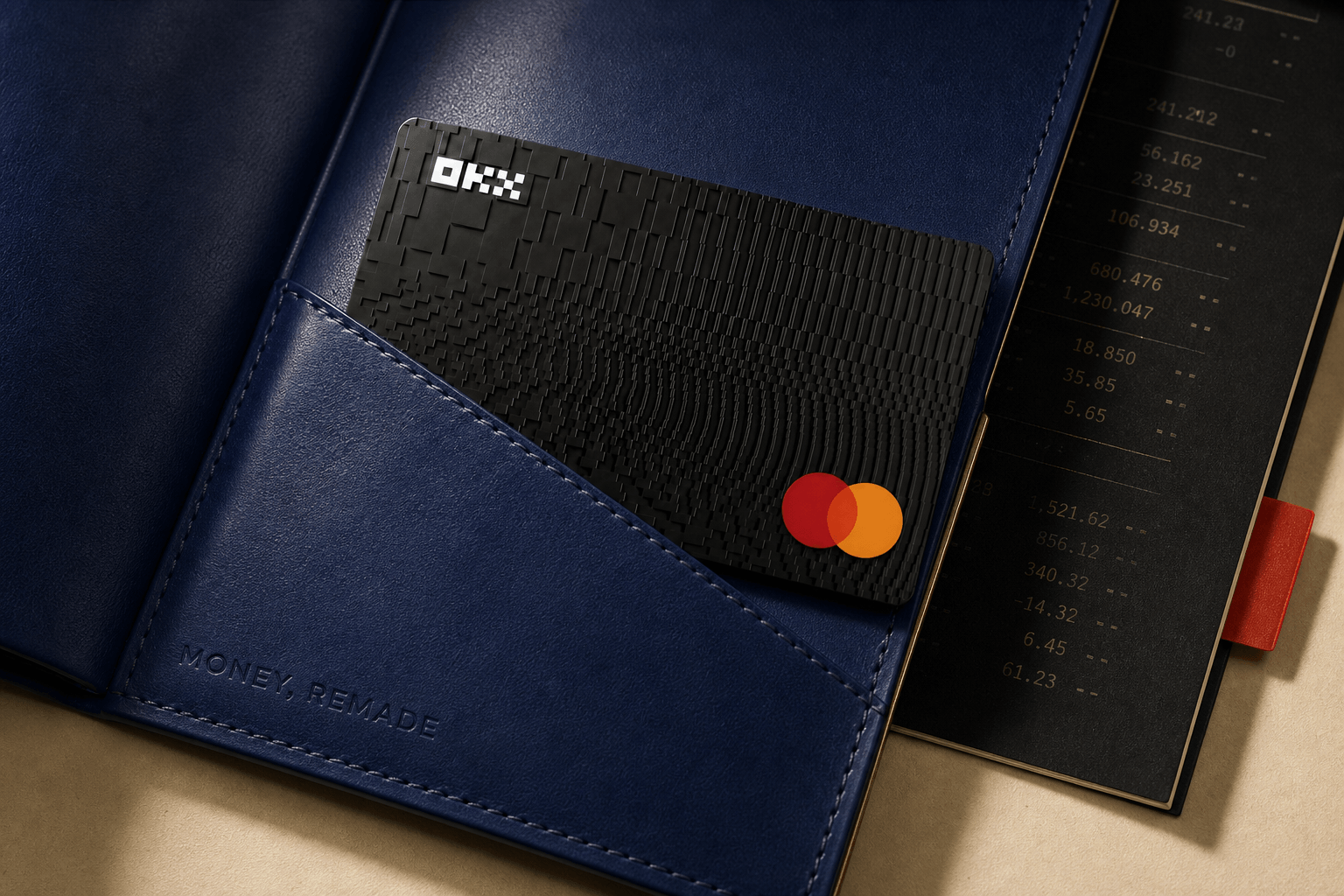
PRODUCTOKX Card
MONEY, REMADE / EDITORIAL VIEW
Many CEX cards behave like withdrawal valves attached to a trading account. OKX made a more considered choice. Purchases draw from Pay, a multi-signature smart wallet inside the app. Money moves into that wallet, waits there and leaves by card authorisation or transfer. Spending has a defined place without losing continuity with the account around it.
That architecture widens the audience. Someone new to OKX finds a virtual card with stablecoin funding, Apple Pay, Google Pay and light listed provider charges. Existing customers continue with the same verified account and any status they already qualify for. A separate OKX Web3 Wallet adds self-custody to the wider app family, while Pay keeps the hybrid control model used for card money.
01 / The wider OKX account
Exchange, Pay and Web3 Wallet offer a custodial trading account, a hybrid payments wallet and separate self-custody. The balances and control models stay distinct.
The custodial account covers trading, account funding and the balances or activity that can qualify a customer for OKX VIP status.
A hybrid multi-signature wallet receives supported funds, handles transfers and supplies the balance used for card authorisation.
OKX's non-custodial wallet is managed separately by the user. Its assets do not automatically become Pay or card funds.
02 / Why the card stands up on its own
Funding, transfers and everyday phone-wallet payments all work at the non-VIP level. Trading volume affects only the reward economics.
A newcomer can make sense of the setup on payment merits. Pay accepts supported value from OKX or onchain, supplies the card and offers transfer paths after funding. The virtual card lists no issuance or monthly fee, and eligible USDG spending earns cashback within a regional allowance.
The format is deliberately digital. Both editions support Apple Pay and Google Pay, while neither offers physical plastic or ATM access. That works well for a phone-wallet routine and less well for anyone who still needs cash withdrawal or a physical fallback.
For an established OKX customer, the mechanics stay familiar and the economics improve. Platform status can enlarge the reward rate and monthly allowance; Global accounts may also earn a variable return on USDG that remains available to spend.
03 / Inside the authorisation
Supported funds sit in a multi-signature wallet until a purchase or transfer uses them. OKX account access, recovery support and regional issuer controls remain part of the arrangement, making Pay a hybrid model.
Issuer of the OKX Card (EEA) payment card.
OKX Card (EEA) programme management.
ELIGIBLE ASSET / NETWORK PAIRS
04 / Card costs
Both editions list no monthly or issuance fee and no additional OKX foreign-exchange markup. EEA adds a 0.1% stablecoin-to-euro conversion spread. Mastercard or Visa conversion rates can still apply, while blockchain transfers may carry network costs.
05 / Money in, money out
The same spending wallet supports internal account funding, blockchain deposits, person-to-person transfers and sends to eligible external addresses.
For an exchange customer, the shortest route is an internal transfer from the linked OKX account. The trading ledger and card money remain separate, so an open position or exchange balance is never treated as an automatic source for a purchase.
Wallet users can receive supported assets into Pay. X Layer is the fee-free Pay route in the current terms, while Ethereum, TRON and additional convert-to-Pay routes extend the network map. Ethereum and TRON can add a Pay wallet-setup charge alongside ordinary network costs; neither belongs to the card transaction fee schedule.
The same Pay balance can move out again. Eligible sends can reach another Pay user, an external wallet address or the exchange account, subject to the asset and network rules shown for that route.
06 / Funding and sending
Exchange transfers, onchain receiving, contact sends and external-wallet transfers each have their own conditions. The routes below show how money gets into Pay, moves to another wallet or returns to the exchange.
Moves supported assets from the linked OKX Exchange account into the Pay balance used by the card.
Credits the Pay balance used by the card after a Pay contact, link or QR-code transfer. · Instant Pay receipt
Receives supported stablecoins into the Pay smart wallet used by the card. · Timing follows X Layer confirmation.
Sends funds to another OKX Pay user on X Layer.
Timing depends on the selected network. · Choose the destination network in the app.
Moves funds from OKX Pay back to your linked OKX Exchange account.
07 / Centralised and web3-native
Trading and account support belong to Exchange; card money lives in Pay; self-custodied assets stay in the separate Web3 Wallet.
The centralised side is familiar: one verified account, an established exchange relationship, customer support and VIP qualification based on broader platform activity. None of those requires the card balance to sit inside the trading ledger.
Pay feels recognisable to a wallet user because it can receive onchain and send to external addresses. Its model is hybrid: the multi-signature design still leaves OKX account access, recovery and issuer controls in the loop.
OKX Web3 Wallet serves the non-custodial part of the ecosystem. Its assets are user-managed and kept apart from Exchange and Pay balances. Moving any of that value toward card spending requires an explicit route into Pay.
08 / Regional contracts
The Pay architecture carries across both editions. Issuer, settlement currency, access rules, reward ceilings and yield treatment follow regional terms.
Global is a StraitsX-backed Visa programme with U.S.-dollar settlement. Its name is not a complete worldwide availability promise; the OKX app makes the final eligibility decision during onboarding.
EEA uses a euro Mastercard issued by UAB Monavate and managed with OKX Europe. The published scope covers EU member states and Norway, with Iceland and Liechtenstein excluded.
The regional distinction reaches beyond the card network. Global can attach variable yield to USDG held in Pay. EEA excludes that feature and follows its own conversion terms, reward caps and qualifying-spend bands.
09 / Programme and form factor
Both editions require identity verification, issue a virtual card, support Apple Pay and Google Pay, and provide no ATM access. EEA publishes a defined regional scope; Global eligibility resolves in the app.
Open the current market list below.
€0
Not available
The application checks identity, residence and the current card programme together. Its live result is the relevant answer for each applicant.
10 / The tier names begin here
The default level pays 2% in USDG with a small monthly cap. Platform status raises the rate and the amount of spend eligible for the full return.
OKX calls the default non-VIP tier Regular. Eligible USDG-funded purchases earn 2% back in USDG. Global fills its $5 monthly allowance after $250 of qualifying spend; EEA fills its €10 allowance after €500.
VIP 1, 2, 3 and 4+ pay 4%, 4.5%, 5% and 10%. Every level has a regional monthly cap and a corresponding full-rate spend band, so the headline percentage is only one part of the calculation.
Qualification comes from the wider OKX platform through balances, trading volume or other eligible activity. There is no paid card membership, card-specific staking requirement or token lock. Customers who already earn VIP status receive the largest advantage; everyone else still has the base card and its 2% programme.
11 / The regional reward ladders
Eligible USDG-funded purchases earn USDG cashback. Global and EEA publish their own ceilings and qualifying-spend bands for Regular and every VIP level.
X-Perps is OKX's derivatives account. EEA status uses total account assets or 30-day trading volume under the applicable schedule. Cashback applies to eligible USDG-funded purchases; excluded categories include gambling, insurance, professional, education, business-support and government services.
No card membership fee
2% USDG cashbackNo card membership fee
4% USDG cashbackNo card membership fee
4.5% USDG cashbackNo card membership fee
5% USDG cashbackNo card membership fee
10% USDG cashback12 / A Global-only feature
Eligible USDG begins earning automatically inside Pay, and the same balance remains available for a card authorisation.
This is the most unusual part of the Global edition. The return accrues on eligible USDG held in Pay, preserving direct access to the balance when a purchase arrives.
For Thailand accounts, OKX has shown 4% for Regular and up to 10% for VIP 3+ on the first 10,000 USDG. The public Global FAQ confirms automatic USDG yield but does not set a universal rate, so each account's live Pay figure remains decisive.
Yield follows the held balance; cashback follows eligible spending and a monthly cap. EEA accounts receive no corresponding USDG yield feature.
13 / USDG between purchases
Global can place a variable return on eligible USDG that remains available to spend. EEA makes no equivalent yield promise.
14 / Editorial position
OKX Card makes a coherent case for using one provider across an exchange account, stablecoin payments and a separate self-custody wallet. Pay gives the card its own hybrid spending balance. At non-VIP level, the product already covers the daily routine of a phone-wallet user who accepts modest reward caps and no physical or ATM form factor. Existing VIP status, plus spendable USDG yield where Global offers it, turns that foundation into a materially stronger package.
15 / Sources
Official pages cover the smart-wallet model, account and onchain movement, regional card terms, USDG rewards, VIP qualification, Global yield, and the different roles of Exchange and Web3 Wallet.
Questions / Two programmes, distinct terms
Global and EEA share the Pay idea, while their contracts and product details remain separate.
They share the OKX Pay concept, but each programme keeps its own issuer, card network, settlement currency, availability, rewards and sources. Use the selector for the applicable details.
In either programme, purchases draw from the dedicated Pay smart-wallet balance. Exchange balances and the separate self-custody Web3 Wallet become card money only after value follows a supported route into Pay.
Spendable variable yield on USDG is documented for Global. The current EEA programme does not offer an equivalent yield feature.
No. Global eligibility resolves in the OKX app, while EEA follows its own published regional scope and onboarding decision.
No. Receiving or sending through Pay can carry route-specific network costs, which remain separate from card-purchase charges under the selected programme.