← Products
MONEY, REMADE / Product analysis / A small network, tightly assembled
Solid connects savings, borrowing and card spending on Fuse.
Solid assembles Fuse's fast, low-cost rails, a self-custody wallet, soUSD Savings and collateral-backed card spending inside one compact virtual account. Regular cashback arrives in USDC and immediately joins the productive side of the balance.
18 official sources · checked Aug 5, 2026
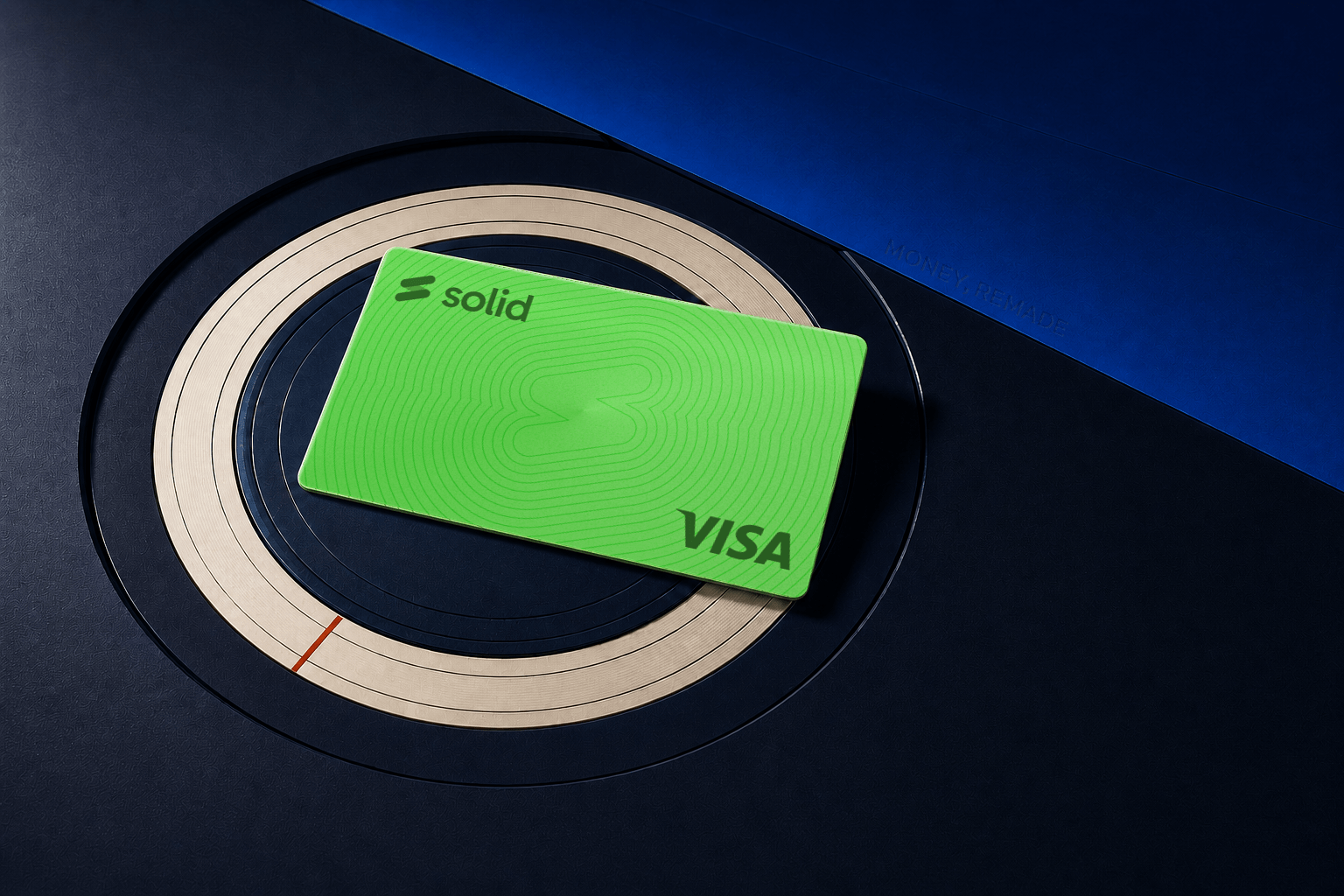
PRODUCTSolid Card
Monthly fee$0
Base reward3%
Account modelSelf Custody
Virtual onlyCredit-line Visa
MONEY, REMADE / EDITORIAL VIEW
Solid's strongest idea is integration. Network, wallet, vault and card behave as one financial system, giving a lesser-known consumer brand unusual range while keeping the consequences of its DeFi machinery visible.
Fuse has spent years building an EVM-compatible network around quick, inexpensive transactions and payment-oriented tooling. It remains a specialist name beside the giants of consumer finance. Solid is its most persuasive argument that a niche chain can support a polished account for ordinary money.
A wallet, USD virtual account, Savings position and Visa card share the same compact interface. Stablecoins can arrive from several networks; eligible users can receive ACH or wire deposits; Apple Pay and Google Pay carry the virtual card into a familiar checkout. The route map is broad even when the screen feels restrained.
Regular card cashback follows a particularly thoughtful path. Solid pays it in USDC, sends it to Savings and converts it into soUSD, where it begins earning a variable return. A purchase therefore leaves behind an asset that can keep working after the reward has been credited.
Borrow Mode supplies the boldest piece. soUSD can remain invested as collateral while borrowed USDC funds the card, with an official product article illustrating a borrowing ratio around 70%. That liquidity comes with interest and a possible liquidation event. Solid explains both sides with the candour expected from serious DeFi infrastructure.
01 / The everyday ledger
Most card charges have disappeared from the table.
Monthly maintenance, virtual issuance, top-up, USD spending and card conversion are listed at $0. Non-USD purchases carry 1% foreign exchange. Savings has its own economics: Solid takes 10% of generated yield, and a 0.01% solver fee can apply when funds leave the vault.
Virtual Visa in app after KYC; activation requires at least $10 in Wallet or Savings
02 / Fuse beneath the surface
The network earns its place by disappearing.
Fast confirmation and tiny network costs give the product room to automate financial actions without turning each one into a lesson about gas.
Fuse documents block confirmations below five seconds and typical network costs around a ten-thousandth of a dollar. EVM compatibility keeps the chain close to established Ethereum tooling, while its payment focus gives the infrastructure a clear consumer purpose.
The wider Fuse stack includes FuseBox, an account-abstraction toolkit for smart wallets and sponsored transactions. Solid's own architecture names Safe, Turnkey and Pimlico for wallet controls and transaction handling. Those layers are allowed to stay backstage while the app speaks in balances, cards and transfers.
Low-cost infrastructure matters most when it changes product behaviour. Cashback can move into Savings automatically; wallet transactions can be sponsored; a vault withdrawal can return to the spending path. Small actions become practical enough to connect.
03 / Money entering and leaving
Wallet rails and a USD account feed the same system.
Eligible users can receive dollars through ACH or wire into a virtual account that settles into soUSD. Fuse-native wallet routes carry supported assets outward, with the route-specific fee and timing attached below.
Own-name bank deposits have no stated Solid per-transaction, monthly or yearly limit. Third-party deposits are available up to $4,000/transfer. Available only for eligible users/locations after KYC/KYB; the Virtual Account itself does not hold a separate balance. · Wire can arrive same business day; ACH usually clears within a few business days
Timing follows Fuse confirmation. · Solid wallet on Fuse and supported external networks · Limits shown in app before confirmation
04 / The productive balance
soUSD is the hinge inside Solid.
The Savings token connects stablecoin deposits, managed DeFi strategies, cashback and card liquidity without pretending that each feature has the same risk.
USDC and USDT placed in Savings are represented through soUSD, an ERC-4626-compatible vault position. Its return comes from strategies across lending and other stablecoin yield markets; the rate moves with those underlying opportunities.
Veda's modular BoringVault infrastructure provides the vault framework. Solid also names Morpho and Pendle among the protocols used by its strategy system. This is a comparatively restrained palette by DeFi standards, centred on stablecoin liquidity and established onchain primitives.
The comparison ends at the edge of DeFi. soUSD is not an insured bank deposit, its return is not guaranteed and its strategy carries smart-contract, protocol, liquidity, market and peg risks. Withdrawals may enter a queue, which gives the vault time to unwind positions instead of promising cash-like immediacy under every condition.
05 / Savings in numbers
The rate is variable; the balance has several jobs.
Solid Savings publishes an indicative return for soUSD and keeps the position separate from the card balance. Funds can move into the card balance, or the soUSD position can remain in place as collateral for Borrow Mode.
BoringVault-based soUSD vault strategies
70% in the cited product example; USDC supplies the card liquidity; collateral continues to follow its yield strategy; borrowing cost is variable; liquidation risk applies
06 / Collateral-backed spending
A card purchase can begin as a loan against savings.
Borrow Mode creates spendable USDC while the soUSD position stays in the vault and continues to follow its yield strategy.
Solid's worked example places a $700 loan beside $1,000 of Savings, describing a borrowing ratio around 70%. The borrowed USDC reaches the card; the soUSD remains invested. Someone can meet a payment without closing the underlying Savings position.
The arithmetic is dynamic. Borrowing cost moves with the facility, while collateral value and outstanding card obligations determine the health of the position. Yield may offset part of the interest, yet the two rates are independent and neither is fixed by the other.
Liquidation remains possible if collateral no longer covers the obligation under the programme terms. Experienced DeFi users will recognise the bargain immediately: capital efficiency in exchange for active risk management. Solid brings that native onchain trade into a consumer card with unusually direct documentation.
07 / The rewards ladder
Three percent arrives before any paid membership.
Every member starts at Core with 3% in USDC and a $50 monthly cashback cap. Prime moves to 4% and $100 after 5 million Solid Rewards points; Ultra reaches 5% and $200 after 35 million points.
Core
Free
3% cashback- How to qualify
- All members
- Monthly cashback cap
- $50 / month
- Full-rate spend
- Full rate on the first $1,666.67 / month
- After that band
- 0% after the full-rate band
- Card programme
- Virtual Visa
- Virtual card
- Virtual card in app
- Physical card
- Not offered
- 3% USDC cashback
- $50 monthly cashback cap
- No paid subscription
Prime
Free
4% cashback- How to qualify
- 5,000,000 Solid Rewards points
- Monthly cashback cap
- $100 / month
- Full-rate spend
- Full rate on the first $2,500 / month
- After that band
- 0% after the full-rate band
- Card programme
- Virtual Visa
- Virtual card
- Virtual card in app
- Physical card
- Not offered
- 4% USDC cashback
- $100 monthly cashback cap
- Unlocked through rewards points
Ultra
Free
5% cashback- How to qualify
- 35,000,000 Solid Rewards points
- Monthly cashback cap
- $200 / month
- Full-rate spend
- Full rate on the first $4,000 / month
- After that band
- 0% after the full-rate band
- Card programme
- Virtual Visa
- Virtual card
- Virtual card in app
- Physical card
- Not offered
- 5% USDC cashback
- $200 monthly cashback cap
- Highest points-based tier
08 / The operating literature
The difficult parts are written down.
Solid's help centre treats fees, fund flows, vault contracts and risk disclosures as pieces of the interface.
Separate articles trace deposits into Wallet and Savings, explain the automatic USDC-to-soUSD conversion, list the protocols beneath the vault and describe the return path to the card. The reader can follow money across the system without relying on one simplified marketing diagram.
The fee documents are equally specific. The current help-centre schedule quotes 1% foreign exchange and no cross-border charge, while international card terms preserve a contractual ceiling of up to 3% for FX or cross-border costs. The everyday rate is clear; the operative agreement still has the final word.
Risk receives the same treatment. Smart-contract exposure, strategy loss, liquidity constraints and liquidation appear in dedicated explanations. That level of detail makes the ambitious mechanics easier to appreciate because their boundaries are available before the money moves.
09 / Product anatomy
A compact brand sits on a broad technical stack.
Self-custody wallet controls, Fuse settlement, Visa acceptance, regional issuers and Veda-based yield infrastructure keep distinct responsibilities inside the product.
Issues the card and performs issuer functions under the US consumer agreement.
Provides access to the Solid card programme and associated product services.
ELIGIBLE ASSET / NETWORK PAIRS
10 / Access and form factor
The card lives on screen for now.
Current documentation lists card access across 49 countries and more than 30 U.S. states. Identity verification is required. The issued card is virtual, works with Apple Pay and Google Pay, and does not currently provide a physical card or ATM access.
Open the current market list below.
No physical card confirmed
See all 48 markets in the current signup list
Antigua & BarbudaArgentinaAustraliaBahamasBangladeshBarbadosBelizeBoliviaBrazilCayman IslandsColombiaCosta RicaCôte d’IvoireDominican RepublicEcuadorEgyptEl SalvadorGhanaGrenadaGuatemalaGuyanaHondurasHong Kong SAR ChinaJapanKenyaMalaysiaMexicoMoroccoNew ZealandPakistanPanamaParaguayPeruPhilippinesSenegalSingaporeSouth AfricaSt. Kitts & NevisSt. LuciaSt. Vincent & GrenadinesSurinameThailandTrinidad & TobagoTurks & Caicos IslandsUgandaUnited Arab EmiratesUruguayZambia
See 17 markets explicitly excluded in the current documentation
BelarusChinaCubaIndiaIranIraqIsraelMyanmar (Burma)NepalNicaraguaNorth KoreaRussiaSyriaTürkiyeUkraineVenezuelaVietnam
The application checks identity, residence and the current card programme together. Its live result is the relevant answer for each applicant.
11 / Closing note
A serious DeFi account from the quieter side of the market.
Solid gives Fuse a convincing consumer form. Its everyday card pricing is exceptionally light, Core cashback is immediately useful in USDC, and soUSD lets one balance participate in rewards, yield and collateral-backed spending. The absence of a physical card narrows the audience; vault and borrowing risks ask for genuine DeFi literacy. For the user who understands those mechanics, the whole system feels focused, generous and remarkably well made.
12 / Sources
The fee schedules, fund flows and network manuals behind this note.
These official pages cover current USDC cashback, membership, card pricing, soUSD strategies, Borrow Mode, Fuse infrastructure and regional access.
01How current Solid cashback worksOfficial rewards information02Solid Rewards terms and conditionsOfficial rewards terms03Solid Card fees and limitsOfficial card fee schedule04Understanding Solid's feesOfficial account and Savings fee information05Borrow against Savings with the Solid CardOfficial Borrow Mode overview06A transparent look inside Solid's automated yield engineOfficial yield architecture overview07Fuse network technical overviewOfficial network documentation08Veda BoringVault architecture and flow of fundsOfficial vault infrastructure documentation09How Solid leverages the Fuse stackOfficial network architecture overview10Where Solid is availableOfficial availability information
18 official sources · checked Aug 5, 2026
Questions / One interface, several balances
Where saving ends and spending begins.
Wallet, Savings and card liquidity sit close together without becoming the same financial position.
Are Wallet, Savings and the card one balance?
They share one product interface but keep different jobs: Wallet holds assets, Savings holds soUSD, and the card uses prepared funds or credit.
How can soUSD support a purchase?
It can be converted toward card funding, or remain in Savings as collateral while borrowed USDC supplies liquidity. The borrowing route adds variable cost and liquidation risk.
Does cashback arrive as card-ready money?
The documented route sends USDC rewards into Savings and converts them to soUSD, so the reward joins the productive balance rather than the card balance.
Is soUSD a bank deposit?
soUSD is an onchain vault position rather than an insured bank deposit. Its return is variable and its strategies carry smart-contract, protocol, liquidity, market and peg risks.
Why might a Savings withdrawal take time?
A withdrawal can enter a queue while the vault unwinds underlying positions. It must return through the relevant balance route before the card can use it.