Supported assets already held in the connected self-custody wallet become available to the card through a revocable spending cap; they are not transferred to a separate card balance. · Available to the card after spending-cap approval · User-selected spending cap
← Products
MONEY, REMADE / Product analysis / Permissioned wallet spending
MetaMask Card turns wallet permission into spending.
MetaMask Card adds everyday spending to an existing self-custody wallet. For someone who already uses MetaMask, the appeal is continuity: the familiar wallet stays in place while the card receives limited, revocable access.
12 official sources · checked Aug 5, 2026
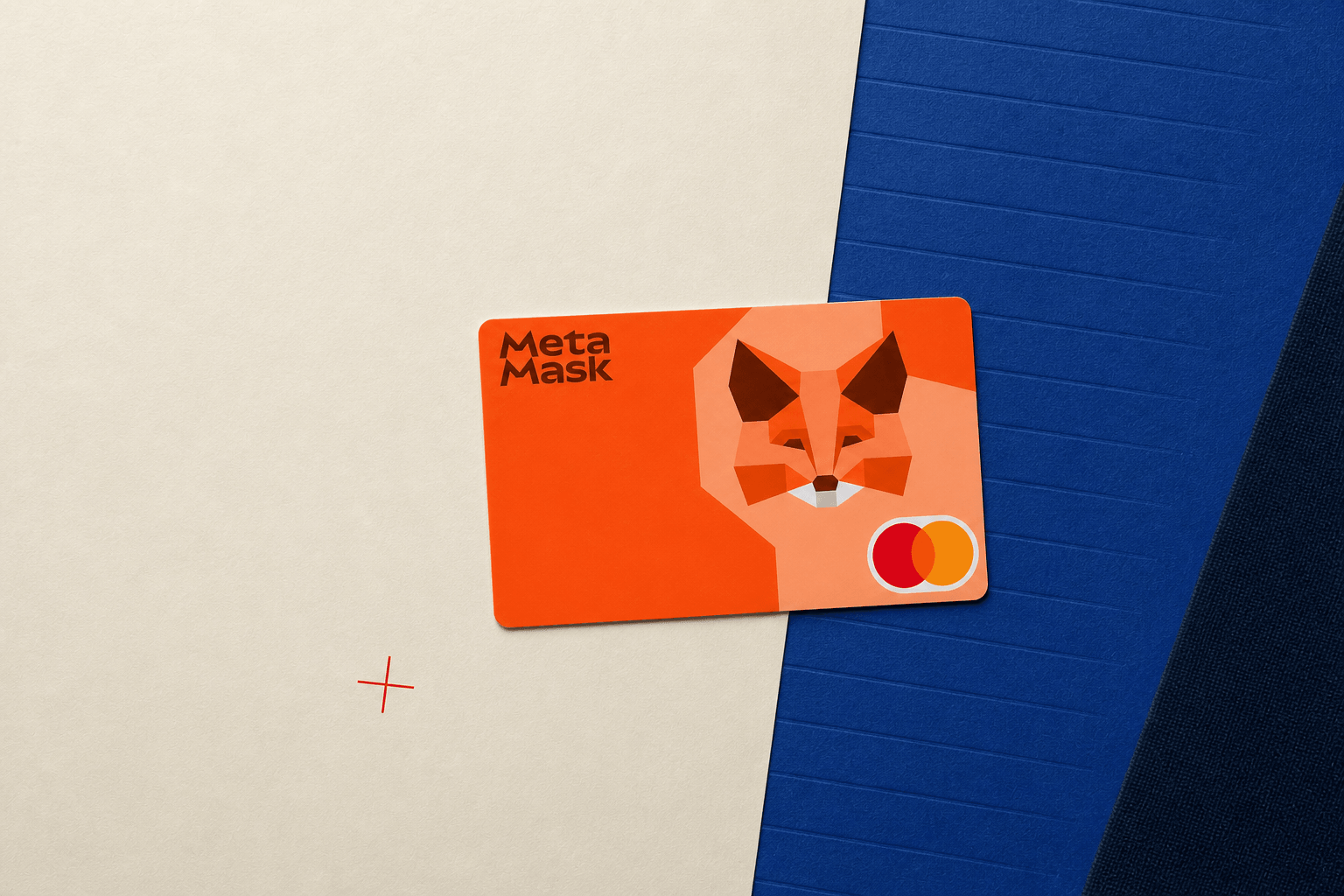
PRODUCTMetaMask Card
Monthly fee$0
Base reward1%
Account modelSelf Custody
Virtual · physical orders pausedDebit Mastercard
MONEY, REMADE / EDITORIAL VIEW
If MetaMask is already where you manage onchain money, the card extends that environment without introducing a separate prefunded balance. You choose the eligible asset, set the spending cap and retain wallet control until a purchase reaches authorization.
For the web3 user who already regards MetaMask as familiar infrastructure, a new card does not need to begin with another place to hold money. It can begin with the wallet that is already there.
Supported assets remain inside the connected self-custody wallet. A per-token spending cap makes a chosen amount available to the card, and conversion occurs during authorization. The instruction prepares the payment while leaving the balance in its existing home.
That gives the wallet another job. Alongside holding assets and approving onchain transactions, it can authorize an ordinary card purchase through a limit that the user may later revoke.
Card networks, identity checks and regulated payment infrastructure still perform their established jobs at purchase. The self-custody boundary determines when they meet the user’s money: wallet control continues until payment calls for settlement.
01 / The funding primitive
Permission is the route into the card.
The important movement happens in authority before it happens in value.
MetaMask Card prepares eligible wallet assets through a spending cap. It creates no separate deposit or receive balance for them. The user selects a supported token and network, then establishes the amount of authority available to the card.
Preparing to pay therefore means defining access. The cap can be revoked, while assets outside the supported combinations stay beyond the card until the user moves or exchanges them into an eligible form.
02 / Money in motion
Follow the permission from wallet to authorization.
The ledger distinguishes wallet access from deposits, transfers and payouts, keeping each route attached to its actual function.
This is delegated card spending from the user's wallet, not a card deposit, receive, crypto-send or bank-payout rail. · Eligible wallet assets are converted during card authorization · Eligible wallet assets on Linea, Solana, Base and Monad; New York and Texas are limited to Linea and Base · Per-token spending caps are set and revocable by the user; card transaction limits vary by tier
03 / The control boundary
The balance stays where it already lives. What moves ahead of the purchase is permission.
At authorization, an eligible asset can be converted for card settlement. Until that moment, the funds remain under the user’s wallet control.
04 / Product anatomy
Self-custody at the beginning, card infrastructure at the edge.
Wallet control, spending authority, conversion, issuing and network acceptance are separate responsibilities inside one purchase.
Card account onboarding and KYC
Card programme and payment infrastructure
US MetaMask Card programme
ELIGIBLE ASSET / NETWORK PAIRS
05 / Three decisions before a purchase
Set the terms of the card before it reaches the terminal.
The experience translates a programmable wallet instruction into an ordinary payment without making the two systems indistinguishable.
Choose
Only listed asset-and-network combinations can receive card access; the rest of the wallet remains outside the permission.
Limit
A user-selected spending cap defines how much authority the card receives and can later be revoked.
Pay
The card carries that narrowly defined access into the established merchant payment network.
06 / Yield at the checkout
Some productive balances can remain spendable.
Supported Aave receipt tokens and the separate MetaMask Money Account can connect variable-return balances to card use. Their yield mechanics and risks remain distinct from cashback.
Third-party DeFi strategies behind the separate MetaMask Money Account
07 / Reward design
One base rate, a higher tier, and a stable reward asset.
Virtual pays 1% in mUSD. Metal raises that rate to 3% on the first $10,000 of annual spend, then returns to 1%; the tier costs $199 a year and new physical orders remain paused.
Virtual
Free
1% mUSD back- How to qualify
- Eligible-region signup and KYC
- How to keep it
- Keep approved tokens enabled and funded in MetaMask wallet
- Full-rate spend
- No value listed for this level
- After that band
- No value listed for this level
- Foreign exchange
- 1%
- Card programme
- Free tier
- Virtual card
- Digital card
- Physical card
- Not included
- 1% mUSD cashback
- $15,000/day card limit
- $1,000/day ATM limit
Metal
$199 / year
3% mUSD back- How to qualify
- US users except Vermont
- How to keep it
- Active annual subscription renews automatically unless cancelled
- Full-rate spend
- Full rate on the first $10,000 / year
- After that band
- 1% after the full-rate band
- Foreign exchange
- 0%
- Card programme
- Premium tier
- Virtual card
- Digital version available after order
- Physical card
- Physical 16g metal card; new orders paused with no reopening date announced
- 3% mUSD back on first $10,000/year
- No foreign transaction fees subject to fair usage
- $30,000/day card limit
- Free ATM withdrawals up to $1,200/month, then 2%
08 / Real economics
Permission still leads to conversion.
Wallet access has no separate card-funding fee. Conversion, foreign exchange, ATM use and the Metal subscription each have their own price and tier conditions.
Paid memberships and their annual terms are listed in the tier ledger above.
Metal tier $199/year; orders temporarily paused as of June 2, 2026
Free tier 2%; Metal no fee up to $1,200/mo, then 2%
09 / Access and onboarding
Open wallet software meets a live card programme.
The current signup list covers 47 markets and identity verification is required. Metal follows a separate US eligibility rule, while new physical-card orders remain paused.
Open the current market list below.
Metal tier $199/year; orders temporarily paused as of June 2, 2026
See all 47 markets in the current signup list
AndorraArgentinaAustriaBahrainBelgiumBrazilBulgariaCanadaChileColombiaCosta RicaCroatiaCyprusDenmarkDominican RepublicEl SalvadorFinlandFranceGermanyGibraltarGreeceGuatemalaGuernseyHungaryIcelandIrelandIsle of ManItalyJerseyLiechtensteinLuxembourgMaltaMexicoMonacoNetherlandsNorwayOmanPanamaPolandPortugalRomaniaSlovakiaSloveniaSpainSwedenSwitzerlandUruguay
See 2 markets explicitly excluded in the current documentation
United KingdomUnited States
The application checks identity, residence and the current card programme together. Its live result is the relevant answer for each applicant.
10 / Closing note
The wallet becomes a payment instrument.
MetaMask Card is easiest to understand as an extension for people who already feel at home in the wallet. A carefully bounded permission turns eligible assets held there into purchasing power, and the user can redefine that boundary after the purchase. Familiar software gains a new financial role without surrendering the self-custody model that made it familiar.
11 / Sources
Where the permission model is documented.
These official product, fee, availability and security pages describe the mechanics used above.
01Spend crypto for everyday purchases with MetaMask Card, crypto cardOfficial Product Page02What is MetaMask Card? | MetaMask Help CenterOfficial Product Page03Limits and fees | MetaMask Help CenterOfficial Fee Page04FAQs | MetaMask Help CenterOfficial Availability Page05MetaMask Metal card | MetaMask Help CenterOfficial Rewards Terms06Security and privacy | MetaMask Help CenterOfficial Kyc Page
12 official sources · checked Aug 5, 2026
Questions / Permission to spend
How the wallet becomes a payment instrument.
The important boundary is the authority granted to the card before a purchase arrives.
Does MetaMask Card require a separate preload?
The card prepares access to eligible assets in the connected self-custody wallet through a per-token spending cap rather than creating a separate prefunded balance.
What does the card's spending permission allow?
It limits card access to the selected eligible token and amount, and the user can revoke it. Other wallet assets remain outside that authority.
When does money leave the self-custody wallet?
Wallet control continues until an authorised purchase calls for conversion and settlement through the card programme.
Can any token or network fund MetaMask Card?
Only listed asset-and-network combinations can receive card access. Other holdings must be moved or exchanged into an eligible form first.
Are card rewards and wallet yield the same thing?
Card cashback arrives as mUSD, while supported Aave receipt tokens and the MetaMask Money Account follow separate variable-return mechanics and risks.