← Products
MONEY, REMADE / Product analysis / A Safe reaches the checkout
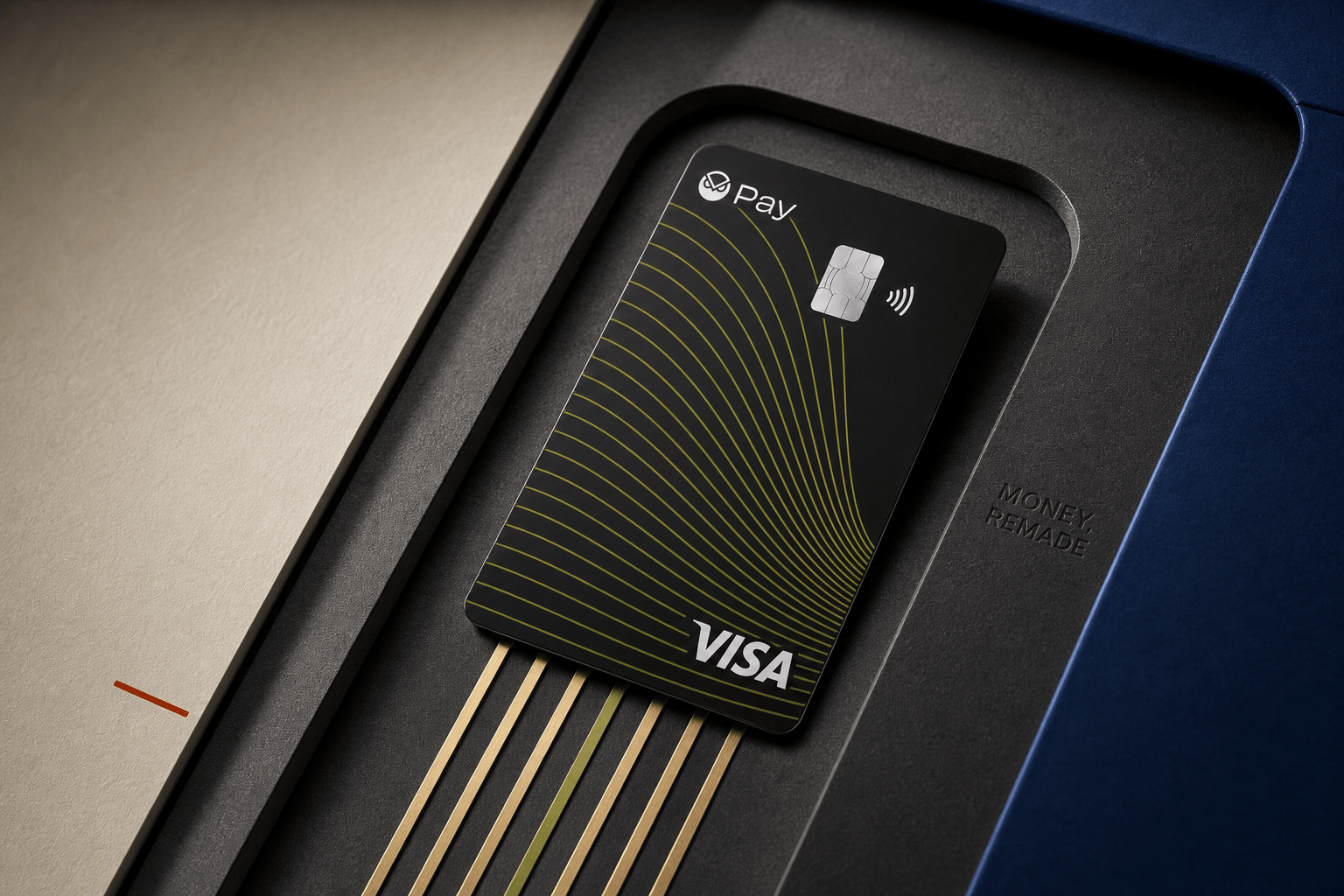
Gnosis Pay lets a Card Safe answer at checkout.
Gnosis Pay connects a user-controlled smart-contract wallet on Gnosis Chain to a Visa debit card. EURe, GBPe and USDCe remain in the Card Safe until an authorised payment draws on them, giving self-custody a practical role in everyday spending.
17 official sources · checked Aug 6, 2026
PRODUCTGnosis Pay
Monthly fee$0
Entry reward1%
Account modelSelf Custody
Virtual + physicalDebit Visa
MONEY, REMADE / EDITORIAL VIEW
A card payment becomes a bounded instruction against a Safe, so control remains with the user up to the moment money moves. The same architecture gives Gnosis Pay its character and its central compromise: the useful balance has to live on Gnosis Chain.
Gnosis entered card payments with unusually long memory of smart-contract accounts. Gnosis Safe grew inside its ecosystem, spun out as Safe in 2022 and became widely used multisignature infrastructure across Ethereum. The card carries its underlying idea of programmable authority over funds into everyday settlement.
A card usually begins with an account balance held by the company that issued it. Gnosis Pay begins with a smart-contract wallet. The user controls the Gnosis Card Safe, and the payment system reaches that wallet through a dedicated spending module when a transaction is authorised.
The distinction survives past the architecture diagram. Supported stablecoins stay onchain until a purchase or transfer requires them. There is no separate exchange balance waiting between the wallet and the Visa network. The financial object is the Safe; the card is one capability attached to it.
That capability has a specific address. Card-ready EURe, GBPe and USDCe must be held on Gnosis Chain. Money elsewhere may need a swap or bridge before it can be spent, bringing an external route, an extra decision and potentially an external cost into the setup.
GNO holders receive a second reason to keep value in the Card Safe. The current opt-in programme pays tiered GNO cashback according to the lowest balance held during each weekly measurement period. Its published end date, 30 September 2026, belongs beside every percentage.
01 / The defining idea
The Safe holds the money. The card carries a tightly bounded instruction to spend it.
Gnosis Pay gives self-custody a place inside a regulated card transaction without asking the user to preload a conventional custodial balance.
02 / Inside one authorisation
A smart-contract wallet sits behind an ordinary tap.
The visible payment belongs to Visa; the balance waiting behind it remains inside the user's Card Safe until the transaction calls for settlement.
The Gnosis Pay spending module connects card authorisation to the Card Safe. It allows the payment programme to use supported assets within defined spending limits while the wider wallet remains under the user's control.
Current limits allow up to 5,000 EURe, GBPe or USDCe in one transaction and 8,000 over a rolling 24 hours. They bound the card's spending authority while the rest of the wallet remains outside the transaction.
Safe wallet infrastructure, Gnosis Pay, Monavate, Paymentology and Visa each perform a different part of the journey. By the time money reaches the terminal, the unusual work has already been organised beneath it and the purchase feels familiar.
03 / Where custody meets acceptance
Custody and card settlement meet at a deliberate boundary.
The Card Safe holds supported assets under user control. A spending module handles card authority; licensed issuing, processing and network partners carry the transaction through the conventional payment system.
Issues the Gnosis Pay card as a licensed financial partner.
Processes Gnosis Pay card transactions.
Provides personal IBAN and bank on/off-ramp functionality.
Provides identity verification during onboarding.
Provides the self-custodial smart-contract wallet infrastructure.
Provides wallet and transaction compliance screening.
Provides blockchain infrastructure used by Gnosis Pay.
Provides smart-account and transaction infrastructure used by Gnosis Pay.
ELIGIBLE ASSET / NETWORK PAIRS
04 / Three objects in one payment
Wallet, instruction and card keep separate jobs.
Understanding the product becomes easier when the balance, the spending authority and the merchant-facing payment are viewed independently.
The balance
EURe, GBPe or USDCe sits in the user-controlled Gnosis Card Safe on Gnosis Chain until an authorised action moves it.
The instruction
The Safe spending module gives the card programme a defined route to eligible funds, subject to the programme's transaction and rolling-day limits.
The payment
Monavate issues the card, Paymentology processes the transaction and Visa supplies merchant acceptance beyond the onchain account.
05 / A live test of the boundary
The card modules proved that self-custody has dependencies of its own.
A June 2026 exploit reached the software connecting Card Safes to payment authority. The response restored users, and the episode made the remaining smart-contract risk unusually concrete.
On 1 June 2026, attackers exploited a vulnerability in the Zodiac Delay and Roles Modules used with Gnosis Pay card-safe infrastructure. Around $1.5 million was extracted. Gnosis paused card services, isolated the affected path and repaired the modules before service resumed in phases.
Gnosis absorbed the loss and restored all user balances; its post-mortem states that no user ultimately lost funds. The replacement modules received focused external review, while the company widened its audit and dependency-monitoring work.
The episode belongs inside the product assessment because the module is central to the card's design. User control protects the wider account boundary, while programmable payment access introduces code and dependency risk at the point where the card reaches into the Safe. The recovery was decisive; the architecture still deserves to be understood in full.
06 / The network commitment
Gnosis Chain supplies the card's entire working home.
Self-custody remains useful at checkout because the wallet, spendable asset and card module share one network environment.
Only three stablecoins currently form the direct card balance: EURe, GBPe and USDCe on Gnosis Chain. An identically named asset on another network does not acquire card access simply because it appears in the same wallet interface.
This creates a clean settlement model and a less flexible funding map. Someone already active on Gnosis Chain can move straight into the Card Safe. Assets arriving from Ethereum, an exchange or another network may need a third-party swap or bridge, whose fee, execution and availability sit outside Gnosis Pay's card pricing.
The chain requirement is therefore the product decision to examine first. It rewards a user who wants one purposeful onchain account for spending. A multi-chain portfolio gains another preparation step before the card becomes useful.
07 / Routes around the Card Safe
Three spendable stablecoins converge on one Card Safe.
Crypto funding arrives on Gnosis Chain without a Gnosis Pay funding fee. A personal Monerium IBAN can convert eligible euro transfers into EURe, while outbound bank movement follows a separate partner-wallet or Monerium route.
Held as a spendable stablecoin in the Gnosis Card Safe · Supported asset and network combinations
Monerium-powered personal IBAN funding converts EUR to EURe 1:1 before the user moves funds to the Gnosis Card Safe. Limits: EUR 950 daily / EUR 5,000 weekly / EUR 20,000 monthly. The IBAN is receive-only; third-party transfers can be delayed by manual review or rejected. · Own-name transfers can be instant 24/7; third-party transfers are manually reviewed Monday-Friday, 09:00-16:00 UTC
Card authorization uses the Gnosis Pay Safe spending module · Gnosis Card Safe on Gnosis Chain with approved wallet spending caps · 8,000 EURe/GBPe/USDCe per rolling 24 hours; 5,000 EURe/GBPe/USDCe per transaction
Official Gnosis Pay docs describe IBAN outbound as an advanced bank-withdrawal path through supported partner wallets or Monerium; it is not a built-in one-click withdrawal from the Gnosis Pay app. · SEPA timing depends on partner wallet, Monerium and bank processing · Supported partner wallets or manual Monerium flow · Limits shown by partner wallet or Monerium
08 / A bank rail into the Safe
The personal IBAN turns euros into an onchain card balance.
Monerium supplies a receive-only account route that converts EUR into EURe at one-to-one value before the funds move into the Card Safe.
Own-name transfers can arrive through the personal IBAN around the clock and may settle instantly. The documented limits are EUR 950 a day, EUR 5,000 a week and EUR 20,000 a month. Gnosis Pay lists no receiving fee, although the sending bank can still charge for its side of the transfer.
Third-party transfers follow a narrower operating window. They are reviewed manually from Monday to Friday between 09:00 and 16:00 UTC, and can be delayed or rejected. The route works best as a personal funding instrument, exactly as the account ownership suggests.
The IBAN does not provide a symmetrical withdrawal button. Sending EURe back to a bank account uses supported partner wallets or Monerium's own process, with the available fee, limit and timing shown along that route.
09 / The quiet fee table
Card spending keeps the fee schedule unusually light.
Monthly maintenance, supported-stablecoin conversion, foreign exchange and card spending are listed at 0%. The virtual card is free; the physical card carries a one-time price with free shipping. ATM use is free within the published allowance, then costs 2%.
available after the card application is accepted
One-time; shipping free
5 free ATM withdrawals/month or 200 EURe/GBPe/USDCe; then 2%
10 / The GNO measurement week
The week's lowest GNO balance decides the cashback band.
The current programme measures GNO held in the Card Safe from Sunday through Saturday and pays the qualifying reward the following Thursday.
Participation requires an opt-in. Qualification comes from holding GNO in the Card Safe, and no fixed lockup applies. Because the lowest balance during the measurement week determines the band, briefly moving below a threshold can change that week's reward.
Holding 0.1 GNO earns 1% on up to $250 of eligible weekly spend. The next bands are 1 GNO for 2% on $375, 10 GNO for 3% on $500 and 100 GNO for 4% on $1,250. Rewards arrive as GNO in the same Card Safe.
An OG NFT in the Card Safe adds one percentage point when at least 0.1 GNO is also present, lifting the published maximum to 5%. These terms belong to the Intermediary Cashback Programme running through 30 September 2026; a later programme would need its own schedule.
11 / Cashback in numbers
GNO holdings set four weekly reward bands.
The active opt-in programme begins at 1% for 0.1 GNO and reaches 4% for 100 GNO. An eligible OG NFT adds one point, while weekly qualifying-spend bands and the 30 September 2026 end date define the value of every rate.
0.1 GNO held in the Card Safe; opt-in required.
Includes the eligible OG NFT boost; current programme runs through Sep 30, 2026.
0.1 GNO
No membership fee
1% cashback- How to qualify
- Hold 0.1 GNO in the Card Safe
- How to keep it
- Lowest balance measured sunday through saturday
- Full-rate spend
- Up to $250 / week
- Additional reward
- 2% with an eligible OG NFT
- Opt-in required
- Paid in GNO the following thursday
- Current programme ends Sep 30, 2026
1 GNO
No membership fee
2% cashback- How to qualify
- Hold 1 GNO in the Card Safe
- How to keep it
- Lowest balance measured sunday through saturday
- Full-rate spend
- Up to $375 / week
- Additional reward
- 3% with an eligible OG NFT
- Opt-in required
- Paid in GNO the following thursday
- Current programme ends Sep 30, 2026
10 GNO
No membership fee
3% cashback- How to qualify
- Hold 10 GNO in the Card Safe
- How to keep it
- Lowest balance measured sunday through saturday
- Full-rate spend
- Up to $500 / week
- Additional reward
- 4% with an eligible OG NFT
- Opt-in required
- Paid in GNO the following thursday
- Current programme ends Sep 30, 2026
100 GNO
No membership fee
4% cashback- How to qualify
- Hold 100 GNO in the Card Safe
- How to keep it
- Lowest balance measured sunday through saturday
- Full-rate spend
- Up to $1,250 / week
- Additional reward
- 5% with an eligible OG NFT
- Opt-in required
- Paid in GNO the following thursday
- Current programme ends Sep 30, 2026
12 / Access and form factor
A physical and virtual card across the current 37-country list.
Identity verification is required. Virtual issuance can be immediate after acceptance; physical cards, Apple Pay, Google Pay and ATM access give the self-custodial account familiar ways to leave the screen.
Open the current market list below.
30.23 EURe one-time; shipping free
See all 37 markets in the current signup list
ArgentinaAustriaBelgiumBoliviaBrazilBulgariaColombiaCroatiaCyprusCzechiaDenmarkEstoniaFinlandFranceGermanyGreeceHungaryIcelandIrelandItalyLatviaLiechtensteinLithuaniaLuxembourgMaltaMexicoNetherlandsNorwayPolandPortugalRomaniaSlovakiaSloveniaSpainSwedenSwitzerlandUnited Kingdom
The application checks identity, residence and the current card programme together. Its live result is the relevant answer for each applicant.
13 / Last observation
Self-custody becomes useful in the most ordinary place.
Gnosis Pay gives a long-established smart-account idea a credible life beyond treasury and portfolio management. Supported stablecoins remain under the user's control, the spending module carries a limited instruction into the card system, and the transaction emerges as an ordinary Visa payment. Low card charges and time-bound GNO rewards strengthen the proposition. Gnosis Chain supplies the technical coherence and the practical constraint: the card is at its best when that network already feels like home.
14 / Reading file
The wallet, fee and programme documents behind this analysis.
These official pages describe Card Safe spending, supported assets, bank routes, limits, rewards, access and the partners responsible for each stage of payment.
01Gnosis Year in Review 2022Official ecosystem history02How Safe Smart Accounts workOfficial smart-account documentation03Eligible Countries for Gnosis PayOfficial Availability Page04Gnosis Pay accepted KYC documentsOfficial Kyc Page05Understanding Your Card's Fees and Limits – Gnosis PayOfficial Fee Page06Intermediary Cashback Programme – Gnosis PayOfficial Rewards Terms07Post-Mortem: Gnosis Pay Vulnerability Exploit - GnosisOfficial Blog08Gnosis Pay Terms of Service – Gnosis PayOfficial Terms
17 official sources · checked Aug 6, 2026
Questions / The Safe behind the card
How a bounded instruction reaches checkout.
The Card Safe remains the financial account; the Visa card is one capability attached to it.
Where does card-ready money wait?
Eligible stablecoins remain in the user-controlled Card Safe on Gnosis Chain until an authorised purchase invokes the card's spending module.
Can assets on any network answer the card?
The spendable balance has to use supported assets on Gnosis Chain. Money elsewhere may need a separate swap or bridge before it reaches the Safe.
Does the spending module take custody of the whole wallet?
It gives the card a bounded payment instruction against the Safe rather than turning the wider wallet into a provider-held preload.
Can the personal IBAN send money back to a bank?
The personal IBAN is a receiving route. Outbound bank movement uses a supported partner wallet or Monerium process with its own available terms.
Does self-custody remove smart-contract risk?
The card still depends on wallet and spending-module software, so code and dependency risk remain even while the wider Safe stays under user control.